GPEKS Elevated Rail
Economically Viable, Ultra Light Composite Rail
 |
Overview
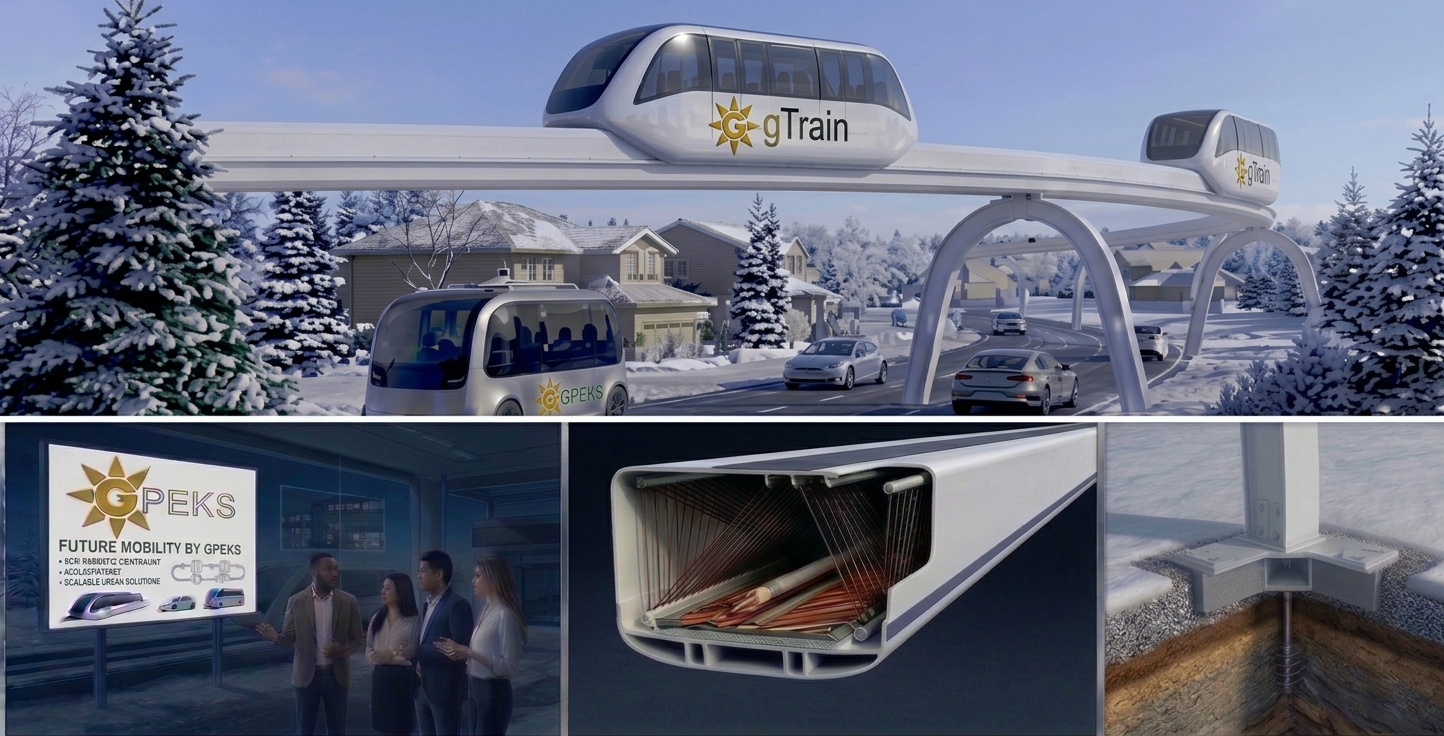
GPEKS is working to deploy ultra Light Rail Train (gTrain) - Elevated High Speed projects in Gatineau, (Canada) and worldwide. The plan is for the urban rail system to initially connect downtown area (Hull) to the western portion of the Gatineau and Pontiac region, and then to the Ontario side. Thanks to the savings possible with that technology versus traditional light rail (tramway), for the same cost as the Aylmer-Ottawa tramway, we will expand the gTrain network to the rest of Gatineau and up north (urban rail). We are also working to expand the Gatineau/Ottawa urban rail system with intercity high speed lines to connect Gatineau to Montreal and Gatineau to Toronto. GPEKS relies on time proven technologies and bankable solutions (with CSA, UL and other recognized certifications). The plan is to have our lines connect Toronto to Detroit and Montreal to New-York via Boston.
Benefits of gTrain project to residents and public administration
- Building Cost: This type of technology provides the lowest building cost compared to any rail system . This allows to charge the lowest possible cost to the travelers, and lowest cost to governments and operators who will be able to pass the savings to travelers and offer lower tickets and monthly passes.
- Maintenance cost: The gTrain offers the lowest operating cost of any ground (or air) transport system. Due to the much higher energy efficiency of any tram rail/light rail systems, energy costs to operate are minimal. No need to clear the tracks from snow and ice in the winter. No need to use herbicides on the tracks to prevent vegetation growth, no need to worry about temperature variations affecting the rail tracks. No need to pay for monitoring gate systems at cross roads... No need to remove debris that tends to accumulate in traditional tramway tracks when recessed in shared lanes... Savings can also be obtained as the elevated rail structure can incorporate power line, telecommunication and fiber optics infrastructure. No more need to prune and trim separate power/utility lines in areas with trees. The system design also saves the space normally required for regular train footprint, especially along Blvd Lucerne and adjacent park areas.
- Speed: reduce the time to access Hull (5 minutes to Marina to Portage for express service, minimal additional time for local service) and Ottawa thanks to a train than can travel twice as fast compared to traditional rail or bus options (150 km/hr peak speed possible). Reduce the congestion on the roads of Gatineau, removing as many cars from the roads as practically feasible, especially in the Aylmer to Hull area and Island Park Drive, Chaudière and Portage bridges.
- Safety: Elevated rail trains can not enter into collision with other vehicles as they do not share any lane or cross any road. They can not derail.
- Comfort: Travellers can enjoy a ride that is smoother than any bus or even any rail ride as the system is silent and there are no traditional rail tracks making 'clickety-clack' sounds.
- Neighboorhood friendly: This type of train requires the least disruption to traffic during constructions, the least expropriations, and when operating will be the most silent system. No annoying horn to warn pedestrians or cars not to cross the tracks. Our option is designed to have the lowest visual impact on the neighborhood environment with the lowest footprint, notably by significant efforts on the aesthetic and landscape integration aspect. The support structures will be painted to match either nature (green ivy pattern paint) or have artistic enhancements. Instead of current rectangular overpass frame structures, elegant arches spanning from pavement to pavement across the roads will be used in areas to provide a futuristic and eye pleasing appearance.
- Space: The GPEKS design allows to save two lanes on the roads, which is a real issue in some areas of downtown or before the University.
- Vehicles: Compared to a traditional ground level train, elevated rail does not use and freeze existing lanes, allowing the fluidest opion for cars, trucks and other vehicles. This will result in the least amount of roads congestion.
- Construction Time: the fastest solution to deploy (half the time compared to traditional tramways).
- Greenest option: This train is the most environmentally friendly type of train on the planet, from both the development and operation perspectives. Its construction does not require tearing down roads and massive excavations, pouring down huge amounts of concrete on the ground, using lots of steel tracks, huge amount of stones and materials for the track ballasts, subgrade layers, heavy rail cars... There is nothing really light in so called traditional 'Light Rail'. Approximately 90% of the conventional rail overpass load is its own weight compared with just 10% for our elevated overpass thanks to the reduced amount of building materials required. GPEKS gTrains use low resistance, aerodynamic rail cars that are made of modern light and strong materials, and only require a tiny fraction of the energy required to move traditional rail.
- Economic development: This will allow for a green economic development of Gatineau with over billions worth of investment in the local economy.
- Complementarity with STO bus system: Thanks to the savings from the construction and operation and maintenance of the gTrain, STO will be able to afford to enhance its network, add more connections where needed, offer more comfortable bus shelters and in more places, electrify its fleet of buses faster.
- Tourism opportunity: People will want to come to the region to experience this innovative and exciting rail system and enjoy beautiful rides along the rivers, parkways, and great views of the city from a much elevated position.
- Investment opportunities: We will offer local real estate investors and residents within view of the rail lines the ability to profit from the project, through high yield project shares offering a superior return on investment.
- Leadership: This project will provide environmental and technological leadership to Quebec, Canada, North America and inspire the rest of the world
More:
Map of the routes for proposed Gatineau area phases:
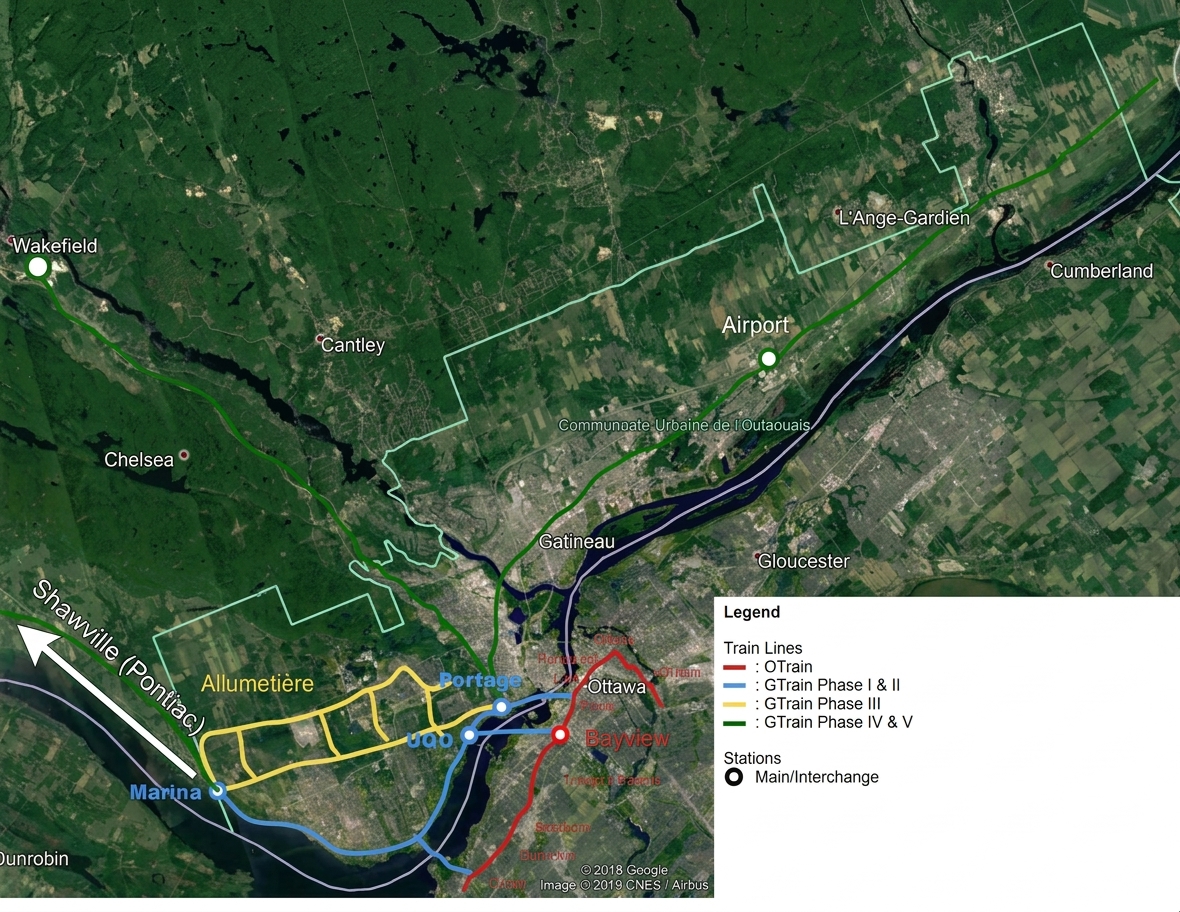
Working with its network of private and public investors, GPEKS is able to arrange for 100% of the funding required for the initial phases I and II of this project, with minimal public grants.
gTrain Project Details
The final location of the line and stations will be determined as result of extensive consultations with the population, municipalities and various stakeholders (UQO, STO, financiers, etc.). A pre-feasibility study has been initiated and will be followed by a more detailed feasibility. Our plan is to work in partnership with academia teams such as Willis College (various disciplines), Ottawa University MBA (business planning), CEGEP (3D Modelling, Graphic design), UQO (Feasibility) and Carleton University (Engineering). The detailed feasibility will feature the construction of a short line segment for the purpose of certification with Transport Canada.
GPEKS will make sure the final line tracing and stations will be situated in logistically strategic locations and places, with easy communication with the other transportation networks, from the STO, and those of OC Transpo and O-Train (Ottawa). The third station of phase I will be close to the campus of the University of Quebec - UQO (behind)
There are many strategic and economic reasons for the proposed tracing (simplification, cost, view of the river, less interference with local traffic ...).
Our plan is to visually integrate the elevated rail line with two sections of vegetation wall (such as cedars) on each side of the lines (when the line does not skirt the park) to hide the lower part. The train will be decorated with wildlife photos of local Canadian forest, trees and animals. Some of the train's panels (or windows) will be covered with electronic signs that can be used to pass promotional videos about the region for example. We plan to cover the walls and roof of the train with BIPV, as well as newest generation of batteries such as printed batteries using nanotechnologies and graphene. The final major technological feature is the possible use of Natural Hydrogen to power inter-city trains without having to connect to the electrical grid.
Residents who live close to the line will have the privilege of being offered shares in the project, with an estimated yield of 15% per year.
Deployment Phases
G-Train Project (Gatineau, Ottawa, Pontiac)
| Network | |||
| Phase 0 | Years 1-3 |
Feasibility study on 800m line with testing of pilot urban rolling stock, Financing, Permitting, Procurement, Engineering
|
0.8 km |
| Phase I | Year 4 | Line 1: Connect Aylmer (Marina) to Vieux Hull (Place du Portage), with 3 'super stations', one on each end, and one at UQO | + 15 km |
| Phase II | Year 5 | Connect the UQO station to Ottawa O-Train Bayview station - Intersection of lines 1 (Confederation) and 2 (Trillium. See O-Train map here. | + 3 km |
| Phase III | Year 6 | Line 2: Connect UQO station to Northern part of Hull (Plateau) with new network for the Plateau (Alumetieres) | + 25 km |
| Phase IV | Year 7 | Add stations to Lines 1 and 2 as required, add North South Lines to connect lines 1 and 2 and to go to Chelsea/Wakefield | + 30 km |
| Phase V | Year 8 | Extension to Gatineau Airport | + 30 km |
Deployment across Québec, Ontario and International
| Network | ||
| Years 5-10 | Provincial Expansions (Canada): Create a high speed inter-urban connection to Montreal and Toronto | 600 km |
International Deployment
| Network | ||
| Year 10-15 | North American Expansion: Connect Toronto to Detroit and Montreal to New-York, . | + 1,600 lm |
| Years 15-17 | International Expansion: Connect Sao-Paulo to Buenos Aires, Singapore to Bangkok, Cape Town to Pretoria.. | + 5,000 km |
Comparison of features of the three main types of Elevated Rail
| SOLUTIONS | Capacity | Maximum Gradient |
|
|---|---|---|---|
| Urban (gTrain) | 25,000 passengers/hour | 45% | |
| Intercity High-speed (gHSTrain) | >500,000 Passengers/day | 20% | |
| Cargo (gCargo) | >200 million tons/year | 60% | |
| River Crossing (gFerry Ropeways) | > Higher than traditional Ferries thanks to all season operation in Canada | N/A |